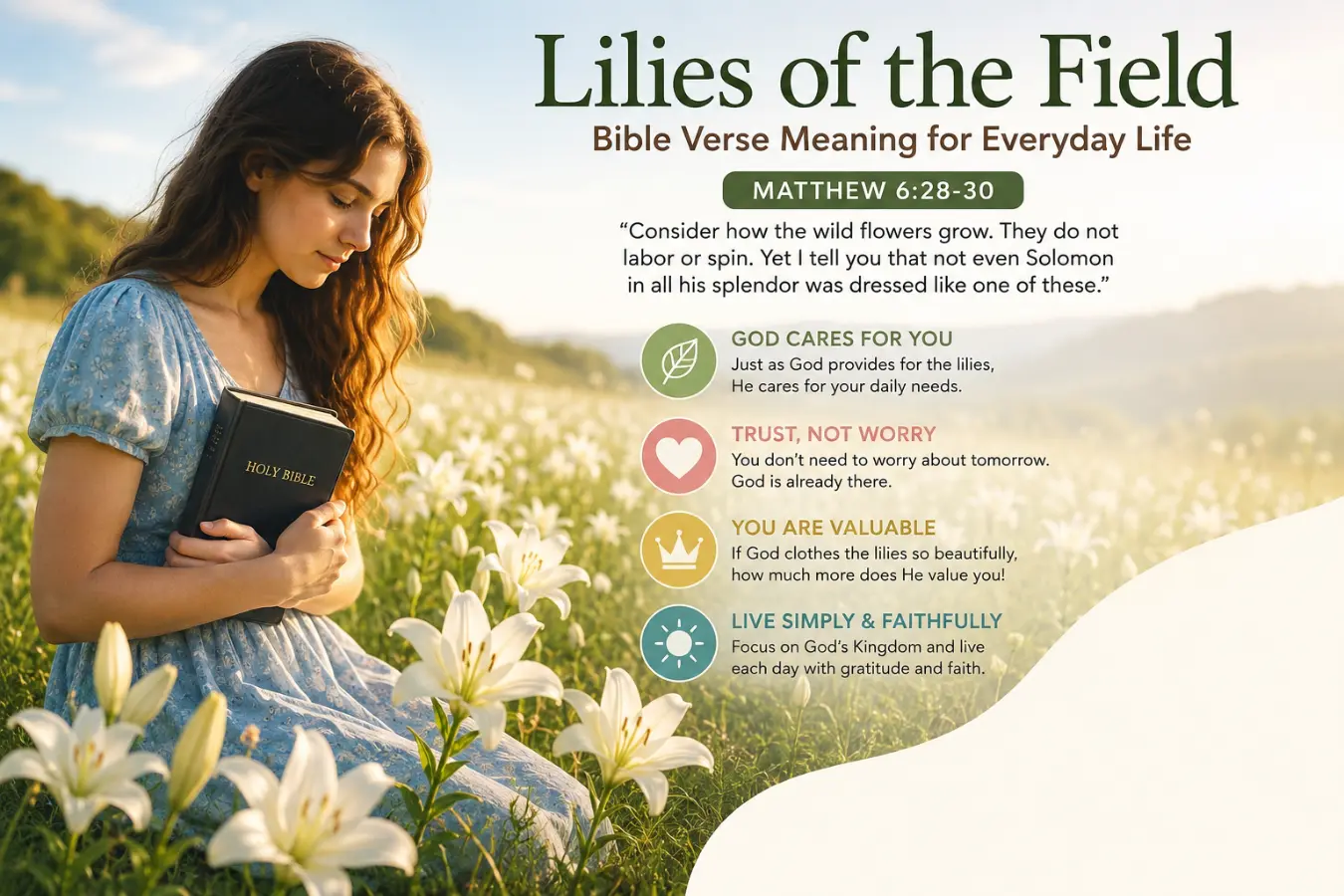
Understanding the Lilies of the Field Bible Verse Meaning for Everyday Life helps believers trust God more deeply in daily situations. In Jesus’ teaching found in Matthew 6:28–30, the lilies of the field serve as a powerful reminder of God’s care, provision, and attention to every detail of creation. The Lilies of the Field Bible Verse Meaning for Everyday Life encourages people to release excessive worry about material needs and place their confidence in God’s faithfulness.
This message remains relevant today because many people face stress about finances, work, health, and the future. Just as God beautifully clothes the flowers that bloom for a short time, He also cares for those who seek Him. The Lilies of the Field Bible Verse Meaning for Everyday Life teaches that trust, gratitude, and faith should replace anxiety. By focusing on God’s provision rather than fear, believers can experience greater peace, contentment, and confidence in their everyday lives.
1. Matthew 6:28–29
Verse
“And why are you anxious about clothing? Consider the lilies of the field, how they grow: they neither toil nor spin, yet I tell you, even Solomon in all his glory was not arrayed like one of these.” (ESV)
Meaning and Commentary
Jesus points to the natural beauty of wildflowers as evidence of God’s creative care. Lilies do not work to create their beauty, yet God clothes them magnificently. Jesus compares them to King Solomon, whose wealth and splendor were legendary.
Practical Application:
Believers can trust that God knows their needs. Instead of being consumed by anxiety over possessions, Christians are called to depend on God’s provision.
Cross-Reference: Proverbs 3:5–6; Philippians 4:19.
2. Matthew 6:30
Verse
“But if God so clothes the grass of the field, which today is alive and tomorrow is thrown into the oven, will he not much more clothe you, O you of little faith?” (ESV)
Meaning and Commentary
Jesus emphasizes humanity’s greater value compared to plants. If God cares for temporary vegetation, He certainly cares for those created in His image.
Practical Application:
When facing financial stress or uncertainty, believers can remember that God’s concern for them exceeds His care for creation.
Cross-Reference: Genesis 1:27; Psalm 8:4–5.
3. Matthew 6:25
Verse
“Therefore I tell you, do not be anxious about your life, what you will eat or what you will drink, nor about your body, what you will put on.” (ESV)
Meaning and Commentary
This verse introduces Jesus’ teaching about worry. He reminds listeners that life is more important than material necessities.
Practical Application:
Christians can prioritize spiritual growth and faithful living rather than allowing fear about the future to dominate their thoughts.
Cross-Reference: Philippians 4:6–7.
4. Matthew 6:26
Verse
“Look at the birds of the air: they neither sow nor reap nor gather into barns, and yet your heavenly Father feeds them.” (ESV)
Meaning and Commentary
The birds serve as another illustration of God’s ongoing care for creation. Jesus teaches that people are of far greater value than birds.
Practical Application:
Observing nature can strengthen faith and remind believers that God remains active in providing for His creation.
Cross-Reference: Psalm 104:27–28.
5. Matthew 6:31–32
Verse
“Therefore do not be anxious, saying, ‘What shall we eat?’ or ‘What shall we drink?’ or ‘What shall we wear?’ For the Gentiles seek after all these things, and your heavenly Father knows that you need them all.” (ESV)
Meaning and Commentary
Jesus distinguishes between a life driven by worry and a life driven by trust. God already knows every genuine need of His children.
Practical Application:
Prayer and faith should replace constant anxiety about daily necessities.
Cross-Reference: 1 Peter 5:7.
6. Matthew 6:33
Verse
“But seek first the kingdom of God and his righteousness, and all these things will be added to you.” (ESV)
Meaning and Commentary
This verse provides the solution to worry. Rather than focusing on material concerns, believers should pursue God’s kingdom and righteousness.
Practical Application:
Make spiritual priorities—prayer, worship, obedience, and service—the foundation of daily life.
Cross-Reference: Colossians 3:1–2.
7. Matthew 6:34
Verse
“Therefore do not be anxious about tomorrow, for tomorrow will be anxious for itself. Sufficient for the day is its own trouble.” (ESV)
Meaning and Commentary
Jesus teaches believers to trust God one day at a time. Worrying about future possibilities often robs people of present peace.
Practical Application:
Focus on today’s responsibilities while entrusting the future to God.
Cross-Reference: Lamentations 3:22–23.
8. Luke 12:27
Verse
“Consider the lilies, how they grow: they neither toil nor spin, yet I tell you, even Solomon in all his glory was not arrayed like one of these.” (ESV)
Meaning and Commentary
Luke records the same lesson found in Matthew. The beauty of lilies demonstrates God’s generous care and creative wisdom.
Practical Application:
Spend time reflecting on God’s handiwork in creation as a way to deepen trust and gratitude.
Cross-Reference: Romans 1:20.
9. Psalm 23:1
Verse
“The Lord is my shepherd; I shall not want.” (ESV)
Meaning and Commentary
Although not directly mentioning lilies, this verse reflects the same principle of God’s provision. Like a shepherd caring for sheep, God cares for His people.
Practical Application:
Trust that God will provide what is truly needed according to His wisdom.
Cross-Reference: John 10:11.
10. Philippians 4:19
Verse
“And my God will supply every need of yours according to his riches in glory in Christ Jesus.” (ESV)
Meaning and Commentary
Paul reinforces the lesson Jesus taught through the lilies. God’s resources are unlimited, and He faithfully meets the needs of His people.
Practical Application:
When facing uncertainty, believers can rely on God’s promises rather than fear or self-reliance.
Cross-Reference: Matthew 6:33.
Biblical Context of the Lilies of the Field
The lilies of the field illustration appears in the Sermon on the Mount (Matthew 5–7) and in Jesus’ teaching recorded in Luke 12. Jesus was addressing common human concerns about food, clothing, and security. Rather than encouraging laziness, He was teaching trust. The lesson is that faithful work should be accompanied by confidence in God’s care rather than anxious striving.
The flowers symbolize both God’s creativity and His provision. Their temporary beauty demonstrates that if God invests such care in short-lived plants, His concern for His children is even greater.
Source and Study Notes
The explanations above are based on the biblical text and general insights commonly found in respected evangelical resources, including the ESV Study Bible, historical context from the Sermon on the Mount, and cross-references from Scripture. Commentary has been adapted and simplified for educational and devotional purposes.
Conclusion
The lilies of the field Bible verse meaning teaches a timeless lesson about faith and trust. Jesus used the beauty of wildflowers to show that God faithfully cares for His creation and values His people even more. These passages encourage believers to replace worry with trust, seek God’s kingdom first, and rely on His daily provision. By reflecting on the lilies of the field, Christians can find peace, confidence, and assurance that their Heavenly Father knows their needs and lovingly cares for them.
Discover More Posts:
God’s beauty in flowers scripture nature revealing God’s glory
Beautiful Bible verses about nature Bible truth in nature
What does the Bible say about roses Bible verses about flowers