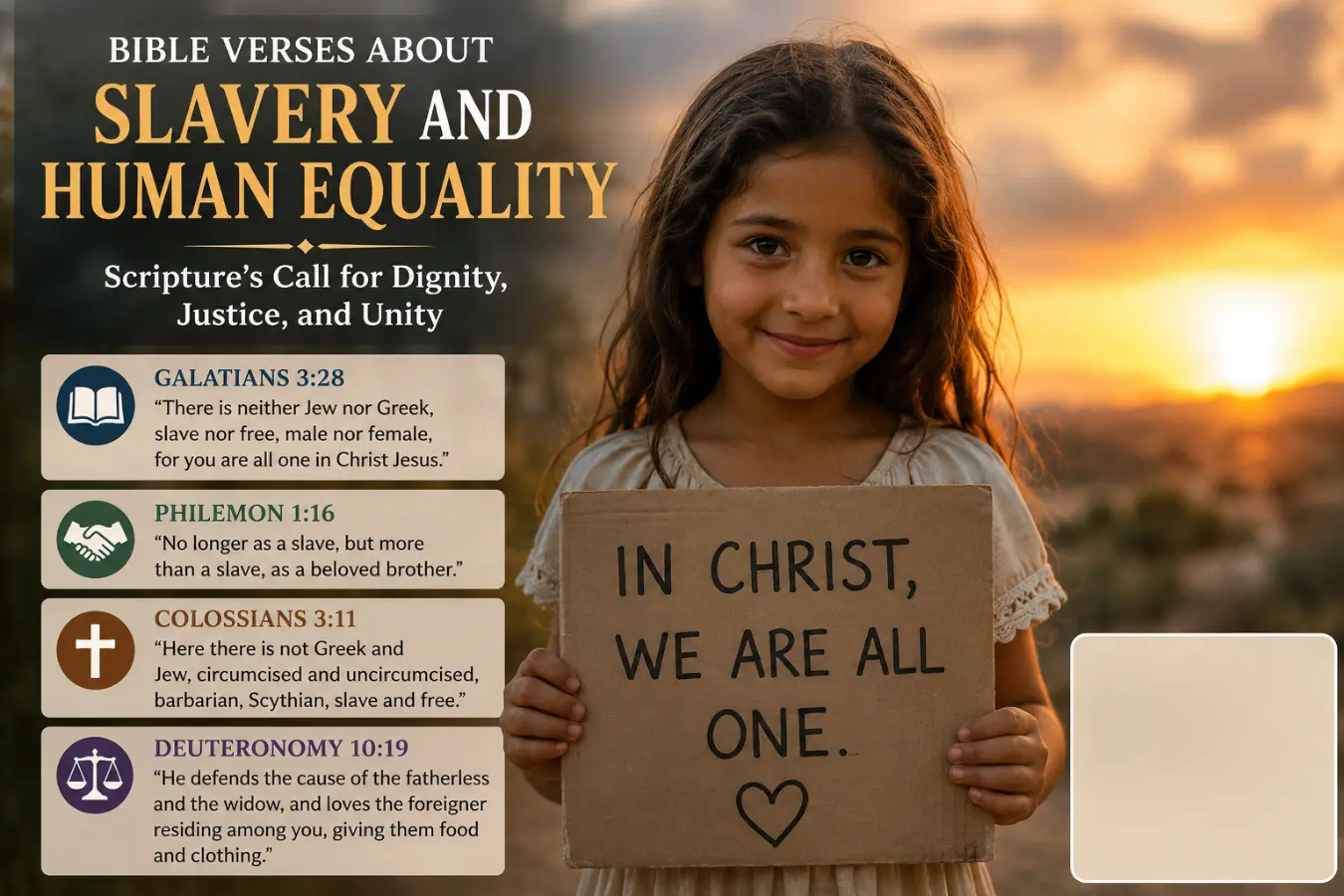
The Bible teaches that every person is created with value, dignity, and purpose in God’s eyes. Bible Verses About Slavery and Human Equality help readers understand how Scripture addresses justice, compassion, freedom, and the equal worth of all people. Throughout history, Christians have studied Bible Verses About Slavery and Human Equality to better understand God’s desire for love, mercy, and respectful treatment of others.
These passages also show how biblical teachings encourage believers to view one another as brothers and sisters rather than as people divided by status or power. By exploring Bible Verses About Slavery and Human Equality, readers can gain spiritual wisdom, historical understanding, and practical lessons about kindness, fairness, and human dignity. Many believers turn to Bible Verses About Slavery and Human Equality for guidance on living with compassion, humility, and respect in today’s world.
1. Exodus 21:16
Verse:
“Whoever steals a man and sells him, and anyone found in possession of him, shall be put to death.”
Commentary
This verse strongly condemns human trafficking and kidnapping. In ancient Israel, stealing a person to sell them as a slave was considered a serious crime deserving severe punishment.
Practical Application
Christians can apply this verse today by opposing human trafficking, exploitation, and all forms of abuse against human dignity.
Cross-Reference
- Deuteronomy 24:7
- 1 Timothy 1:10
2. Galatians 3:28
Verse:
“There is neither Jew nor Greek, there is neither slave nor free, there is no male and female, for you are all one in Christ Jesus.”
Commentary
The Apostle Paul the Apostle teaches that all believers are spiritually equal in Christ. Social status does not determine a person’s value before God.
Practical Application
This verse encourages Christians to treat every person with respect, fairness, and love regardless of background or status.
Cross-Reference
- Colossians 3:11
- James 2:1–9
3. Philemon 1:15–16
Verse:
“Perhaps God separated him from you for a while so that you could have him back forever, no longer as a bondservant but as something greater—a beloved brother.”
Commentary
Paul the Apostle urges Philemon to receive Onesimus not merely as a servant, but as a brother in Christ. This reflects the transforming power of the Gospel in human relationships.
Practical Application
Believers should value reconciliation, forgiveness, and brotherhood above social divisions.
Cross-Reference
- Ephesians 4:32
- Colossians 4:9
4. Ephesians 6:9
Verse:
“Masters, do the same to them, and stop your threatening, knowing that he who is both their Master and yours is in heaven, and that there is no partiality with him.”
Commentary
This verse reminds those in authority that God judges everyone fairly. Masters were instructed to treat servants with kindness and without threats.
Practical Application
Modern employers, leaders, and managers should practice fairness, compassion, and integrity in the workplace.
Cross-Reference
- Colossians 4:1
- Proverbs 22:2
5. Colossians 4:1
Verse:
“Masters, treat your bondservants justly and fairly, knowing that you also have a Master in heaven.”
Commentary
Biblical teaching repeatedly emphasizes justice and fairness. Even within ancient social systems, God demanded ethical treatment of workers and servants.
Practical Application
Christians should advocate for fair treatment, ethical leadership, and respect for workers’ rights.
Cross-Reference
- Micah 6:8
- Luke 6:31
6. 1 Corinthians 7:21
Verse:
“Were you a bondservant when called? Do not be concerned about it. But if you can gain your freedom, avail yourself of the opportunity.”
Commentary
Paul the Apostle acknowledges the reality of servitude in the Roman world while encouraging freedom whenever possible.
Practical Application
This verse reminds believers that spiritual identity in Christ matters deeply, while also affirming the value of freedom and human dignity.
Cross-Reference
- John 8:36
- Romans 6:18
7. Deuteronomy 15:12–15
Verse:
“If your brother, a Hebrew man or a Hebrew woman, is sold to you, he shall serve you six years, and in the seventh year you shall let him go free from you.”
Commentary
Old Testament law provided protections and limits regarding servitude. Servants were not to remain permanently oppressed and were to be released with generosity.
Practical Application
God values mercy, generosity, and restoration. Christians are called to help people rebuild their lives with compassion.
Cross-Reference
- Leviticus 25:39–43
- Isaiah 58:6
8. Leviticus 25:39–40
Verse:
“If your brother becomes poor beside you and sells himself to you, you shall not make him serve as a slave: he shall be with you as a hired worker and as a sojourner.”
Commentary
This passage shows that Israelites were forbidden from treating fellow Israelites harshly. The law emphasized dignity and humane treatment.
Practical Application
Believers should avoid exploiting vulnerable people and instead show kindness and support to those facing hardship.
Cross-Reference
- Proverbs 14:31
- Matthew 7:12
9. 1 Timothy 1:9–10
Verse:
“Understanding this, that the law is not laid down for the just but for the lawless and disobedient… for enslavers, liars, perjurers, and whatever else is contrary to sound doctrine.”
Commentary
Paul the Apostle lists enslavers among sinful behaviors opposed to God’s truth. Many scholars view this as a condemnation of slave trading and human exploitation.
Practical Application
Christians are called to defend justice and stand against systems that abuse or exploit people.
Cross-Reference
- Amos 2:6
- Isaiah 1:17
10. Luke 4:18
Verse:
“The Spirit of the Lord is upon me, because he has anointed me to proclaim good news to the poor… to proclaim liberty to the captives.”
Commentary
Jesus Christ announces a mission of freedom, healing, and restoration. His ministry emphasized compassion for the oppressed and hope for the broken.
Practical Application
Followers of Christ are encouraged to bring hope, justice, and freedom to people suffering from oppression or injustice.
Cross-Reference
- Isaiah 61:1
- John 8:32
Biblical Context and Historical Understanding
Many Bible scholars note that slavery in Biblical times differed in some ways from the race-based chattel slavery practiced in later centuries. In the ancient Near East, servitude was often connected to debt, poverty, or wartime circumstances. However, Scripture also contains clear principles that support justice, mercy, and the equal worth of all people.
Christian theologians throughout history have pointed to verses such as Galatians 3:28 and Philemon 1:16 as foundations for opposing slavery and promoting human equality.
Some commentary insights in this article are adapted from respected Biblical study resources, including the ESV Study Bible and historical Bible commentaries.
Conclusion
The Bible’s passages about slavery must be understood carefully within their historical and spiritual context. While Scripture describes systems of servitude that existed in the ancient world, it consistently teaches justice, compassion, mercy, and the equal value of every person before God.
These verses remind Christians to oppose exploitation, defend human dignity, and practice love toward others. The message of the Gospel ultimately points toward freedom, reconciliation, and unity in Christ. By studying these Scriptures thoughtfully, believers can better understand God’s heart for justice and compassion in both spiritual and practical life today.
Discover More Posts:
Abortion Bible Verses Christian Teachings on Life Before Birth
Bible Verses for Miscarriage Faith and Hope in Difficult Times
Bible Verses for Mourning the Loss of a Loved One