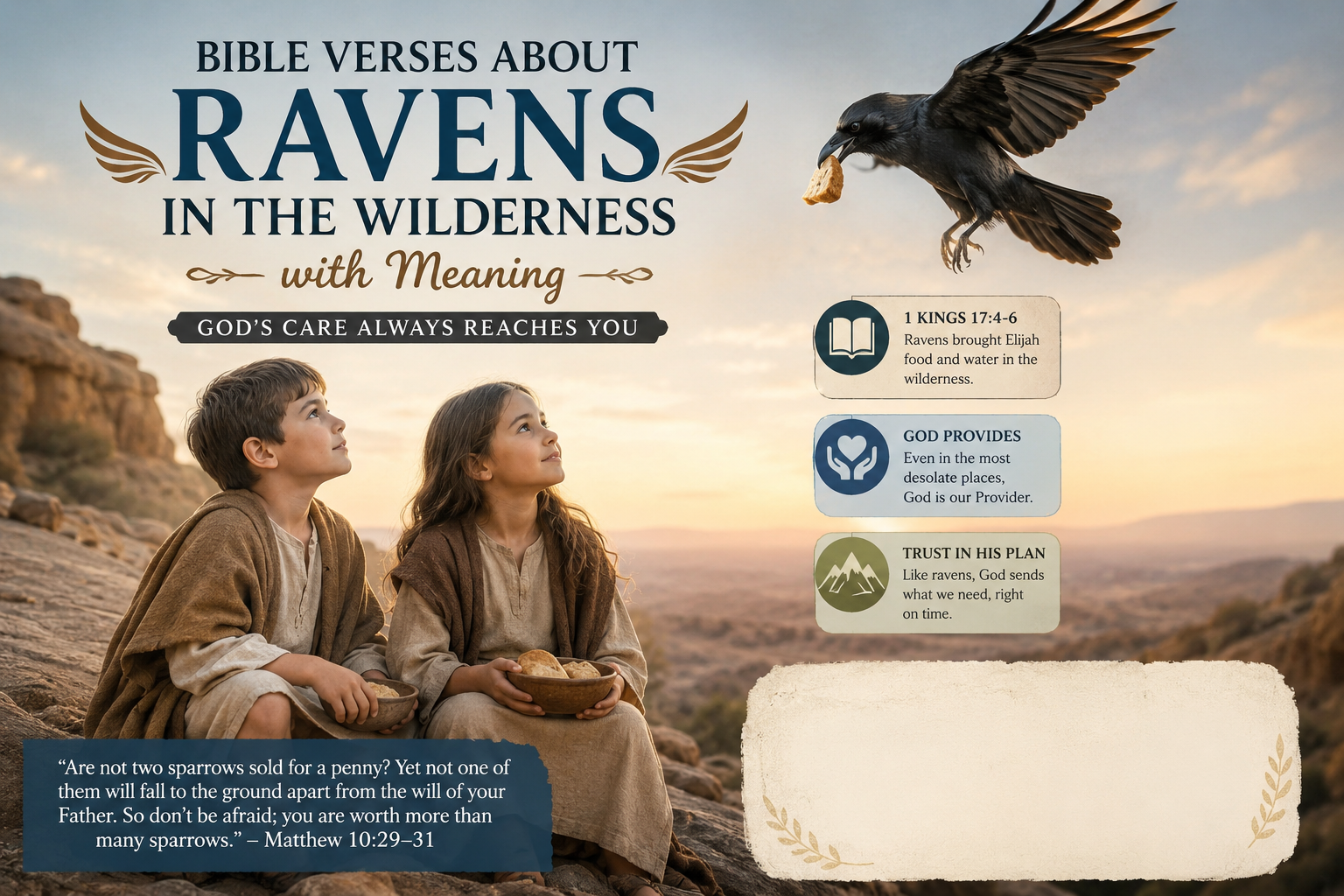
Bible Verses About Ravens in the Wilderness with Meaning reveal powerful lessons about God’s provision, care, and faithfulness during difficult seasons of life. Throughout Scripture, ravens are used as symbols of God’s ability to provide for His people even in the most unlikely circumstances. When studying Bible Verses About Ravens in the Wilderness with Meaning, believers can see how God sustained His servants and demonstrated His sovereign control over creation.
These passages remind us that God’s provision is not limited by human resources or challenging environments. Bible Verses About Ravens in the Wilderness with Meaning encourage Christians to trust God during times of uncertainty, hardship, and spiritual testing. Just as ravens brought food to Elijah in the wilderness, God continues to meet the needs of His people according to His perfect timing and wisdom. By reflecting on Bible Verses About Ravens in the Wilderness with Meaning, readers can gain deeper confidence in God’s promises and find hope in His unfailing care.
1. 1 Kings 17:4
Verse
“You shall drink from the brook, and I have commanded the ravens to feed you there.” (ESV)
Commentary
During a severe drought, God provided for the prophet Elijah in an unexpected way. Ravens, birds often considered unclean under Old Testament law, became instruments of God’s provision. This verse reminds believers that God can use unexpected sources to meet their needs.
Practical Application:
When facing financial, emotional, or spiritual challenges, trust that God can provide in ways you may not anticipate.
Cross-Reference: Matthew 6:26
2. 1 Kings 17:6
Verse
“And the ravens brought him bread and meat in the morning, and bread and meat in the evening, and he drank from the brook.” (ESV)
Commentary
This verse records the fulfillment of God’s promise to Elijah. The ravens faithfully delivered food twice each day. God’s provision was not a one-time miracle but a continual supply.
Practical Application:
God’s faithfulness extends beyond a single moment. He often provides daily strength and resources for ongoing needs.
Cross-Reference: Lamentations 3:22–23
3. Job 38:41
Verse
“Who provides for the raven its prey, when its young ones cry to God for help, and wander about for lack of food?” (ESV)
Commentary
God asks Job a series of questions that reveal His sovereignty over creation. Even young ravens depend on God’s care for survival.
Practical Application:
If God cares for hungry ravens, believers can trust Him to care for their needs as well.
Cross-Reference: Psalm 147:9
4. Psalm 147:9
Verse
“He gives to the beasts their food, and to the young ravens that cry.” (ESV)
Commentary
The psalmist praises God for sustaining all living creatures. Ravens become an example of God’s compassionate care for creation.
Practical Application:
This verse encourages gratitude and confidence in God’s provision, especially during seasons of uncertainty.
Cross-Reference: Matthew 6:30
5. Luke 12:24
Verse
“Consider the ravens: they neither sow nor reap, they have neither storehouse nor barn, and yet God feeds them. Of how much more value are you than the birds!” (ESV)
Commentary
Jesus uses ravens to teach about freedom from anxiety. If God feeds birds that do not gather crops or store food, His children can trust His care.
Practical Application:
Instead of being consumed by worry, bring your concerns to God in prayer and trust His provision.
Cross-Reference: Philippians 4:6–7
6. Matthew 6:26
Verse
“Look at the birds of the air: they neither sow nor reap nor gather into barns, and yet your heavenly Father feeds them. Are you not of more value than they?” (ESV)
Commentary
Although ravens are not specifically named here, this teaching parallels Luke’s reference to ravens. Jesus emphasizes God’s loving care for His people.
Practical Application:
Trust God’s fatherly care rather than allowing fear about the future to dominate your thoughts.
Cross-Reference: Luke 12:24
7. Genesis 8:7
Verse
“And he sent forth a raven. It went to and fro until the waters were dried up from the earth.” (ESV)
Commentary
Noah released a raven after the flood as part of his search for signs that the earth was becoming habitable again. The raven played a role in God’s unfolding plan after judgment.
Practical Application:
God often uses ordinary means and ordinary creatures to accomplish His purposes.
Cross-Reference: Genesis 8:8–12
8. Leviticus 11:15
Verse
“Every raven of any kind.” (ESV)
Commentary
This verse appears in the list of birds considered unclean under the Mosaic Law. Yet despite their ceremonial status, God still cared for ravens and even used them in His plans.
Practical Application:
God’s grace often works through unexpected people and circumstances.
Cross-Reference: 1 Corinthians 1:27
9. Deuteronomy 14:14
Verse
“And every raven of any kind.” (ESV)
Commentary
Like Leviticus 11:15, this passage identifies ravens among unclean birds. The later use of ravens to feed Elijah highlights God’s sovereignty over all creation.
Practical Application:
God is not limited by human expectations. He can use anything within His creation to fulfill His purposes.
Cross-Reference: Isaiah 55:8–9
10. Song of Solomon 5:11
Verse
“His head is the finest gold; his locks are wavy, black as a raven.” (ESV)
Commentary
This poetic description uses the raven’s dark color as a symbol of beauty and strength. While not directly related to wilderness provision, it demonstrates how ravens were familiar and meaningful symbols in biblical culture.
Practical Application:
God’s creation reflects beauty, order, and purpose, pointing people toward the Creator.
Cross-Reference: Romans 1:20
Note on Sources
The commentary above is based on the historical and literary context of Scripture and reflects insights commonly found in respected evangelical resources such as the ESV Study Bible, Bible dictionaries, and conservative biblical scholarship. Readers are encouraged to compare interpretations with the broader context of each passage.
Conclusion
Bible verses about ravens in the wilderness reveal powerful lessons about God’s provision, sovereignty, and care. The account of Elijah shows that God can provide through unexpected means, while passages in Job, Psalms, and the teachings of Jesus remind believers that the Creator faithfully cares for all living things. If God feeds ravens and watches over them, Christians can trust Him to meet their needs as well. These verses encourage faith during difficult seasons, gratitude for daily provision, and confidence that God remains faithful even in life’s wilderness experiences.
Discover More Posts:
Bible Verses About Ravens in the Wilderness with Meaning
Scripture on God’s protection like a bird God’s Shelter in Times
Bible Verses About Singing Birds and Spiritual Lessons