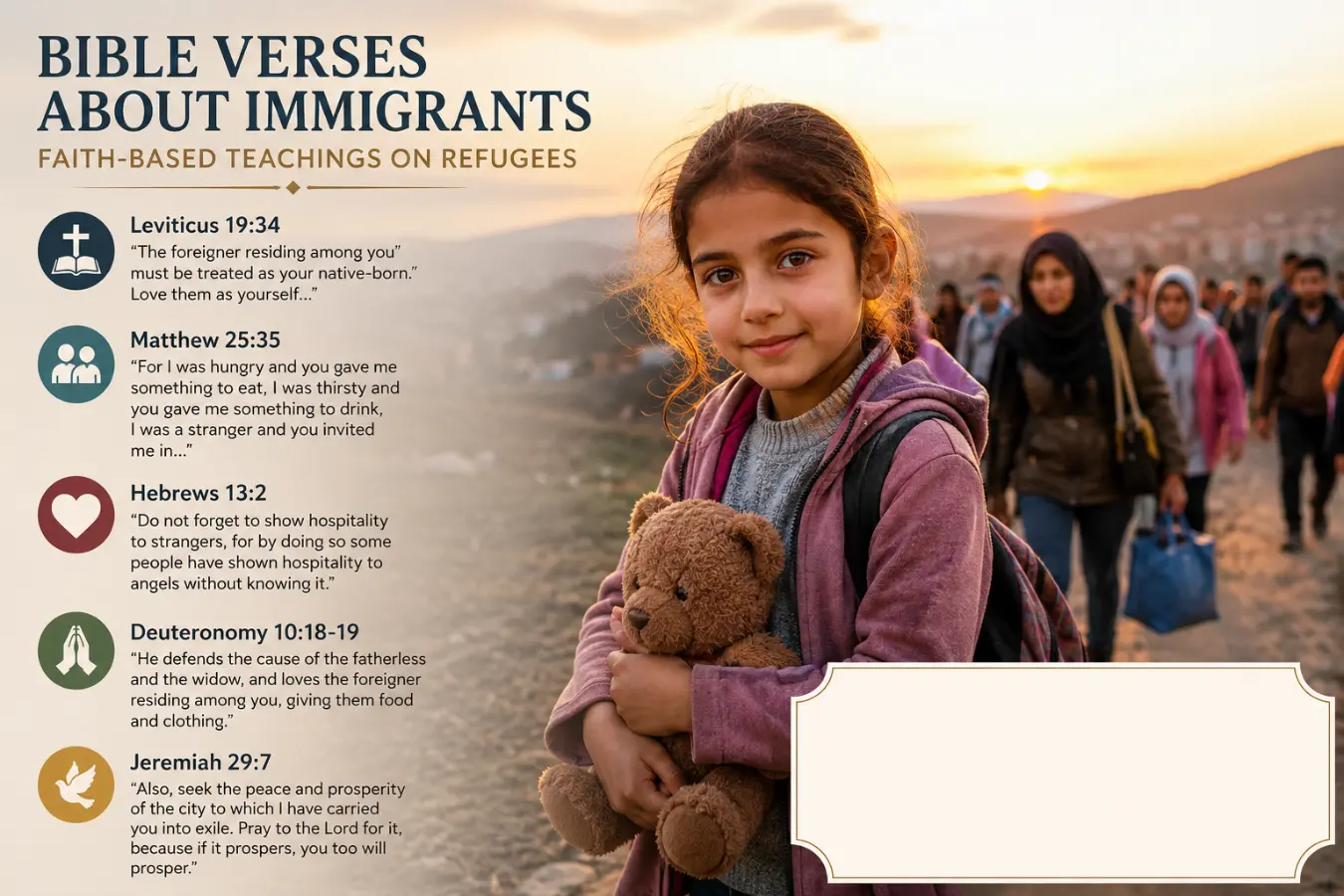
Understanding Bible Verses About Immigrants Faith Based Teachings on Refugees is essential for recognizing how scripture addresses compassion, justice, and care for displaced people around the world. These teachings highlight how faith communities are called to welcome strangers, protect vulnerable families, and reflect God’s love through action, especially when interpreting modern social challenges.
In studying Bible Verses About Immigrants Faith Based Teachings on Refugees, readers discover repeated themes of mercy, hospitality, and moral responsibility that remain relevant today.
Such guidance encourages believers to look beyond borders and see shared humanity, offering practical wisdom for responding with kindness and fairness in difficult situations. Ultimately, Bible Verses About Immigrants Faith Based Teachings on Refugees remind us that spiritual values are deeply connected to how we treat immigrants and refugees in everyday life.
1. Exodus 22:21
Verse:
“You shall not wrong a sojourner or oppress him, for you were sojourners in the land of Egypt.”
Commentary:
God commands Israel to show fairness and compassion to foreigners, reminding them of their own history in Egypt. This verse highlights empathy as a moral responsibility. In modern life, it encourages fair treatment of immigrants in workplaces, communities, and legal systems.
Cross-reference: Leviticus 19:33-34.
2. Leviticus 19:33-34
Verse:
“When a stranger sojourns with you in your land, you shall not do him wrong. You shall treat the stranger who sojourns with you as the native among you, and you shall love him as yourself.”
Commentary:
This passage extends the command beyond justice into love. Immigrants are not merely to be tolerated but embraced. The principle “love him as yourself” mirrors the Great Commandment in the New Testament.
Adapted understanding consistent with ESV Study Bible notes.
3. Deuteronomy 10:18-19
Verse:
“He executes justice for the fatherless and the widow, and loves the sojourner, giving him food and clothing. Love the sojourner, therefore, for you were sojourners in the land of Egypt.”
Commentary:
God identifies Himself as the defender of vulnerable groups, including immigrants. Believers are called to reflect this character by offering care and dignity to outsiders.
4. Hebrews 13:2
Verse:
“Do not neglect to show hospitality to strangers, for thereby some have entertained angels unawares.”
Commentary:
Hospitality is presented as a spiritual duty with eternal significance. This verse encourages openness and generosity toward strangers, including immigrants and refugees.
Cross-reference: Genesis 18 (Abraham’s hospitality).
5. Matthew 25:35
Verse:
“For I was hungry and you gave me food, I was thirsty and you gave me drink, I was a stranger and you welcomed me.”
Commentary:
Jesus identifies Himself with the “stranger,” showing that how we treat immigrants reflects our relationship with Him. This verse emphasizes practical compassion as evidence of true faith.
6. Leviticus 19:9-10
Verse:
“You shall not reap your field right up to its edge… you shall leave them for the poor and for the sojourner.”
Commentary:
God establishes systems of provision for immigrants and the poor. This shows that care for foreigners is not optional but built into God’s social justice design.
7. Psalm 146:9
Verse:
“The LORD watches over the sojourners; he upholds the widow and the fatherless.”
Commentary:
God’s protective care extends especially to vulnerable groups, including immigrants. Believers are called to reflect this divine concern in society.
8. Jeremiah 22:3
Verse:
“Do no wrong or violence to the stranger, the fatherless, and the widow…”
Commentary:
This prophetic command warns against oppression. It highlights that justice toward immigrants is a key marker of righteousness.
9. Zechariah 7:10
Verse:
“Do not oppress the widow, the fatherless, the sojourner, or the poor…”
Commentary:
God repeatedly reinforces the same moral standard through prophets: protect the vulnerable and avoid exploitation. This consistency shows its importance in Scripture.
10. Romans 12:13
Verse:
“Contribute to the needs of the saints and seek to show hospitality.”
Commentary:
The New Testament continues the theme of generosity and hospitality. Early Christian communities were known for welcoming outsiders, including travelers and displaced people.
Conclusion
The Bible presents a clear and consistent message: immigrants and foreigners are to be treated with dignity, compassion, and justice. From the Law of Moses to the teachings of Jesus and the apostles, God calls His people to remember their own history as outsiders and respond with love rather than fear or exclusion. These verses encourage believers today to practice hospitality, advocate for fairness, and reflect God’s heart for all people, regardless of nationality or origin.
Discover More Posts:
Bible verses on grief hope and restoration in christ
Sympathy bible verses for God’s comfort and love
Rest in Peace Death Bible Verses for Funerals