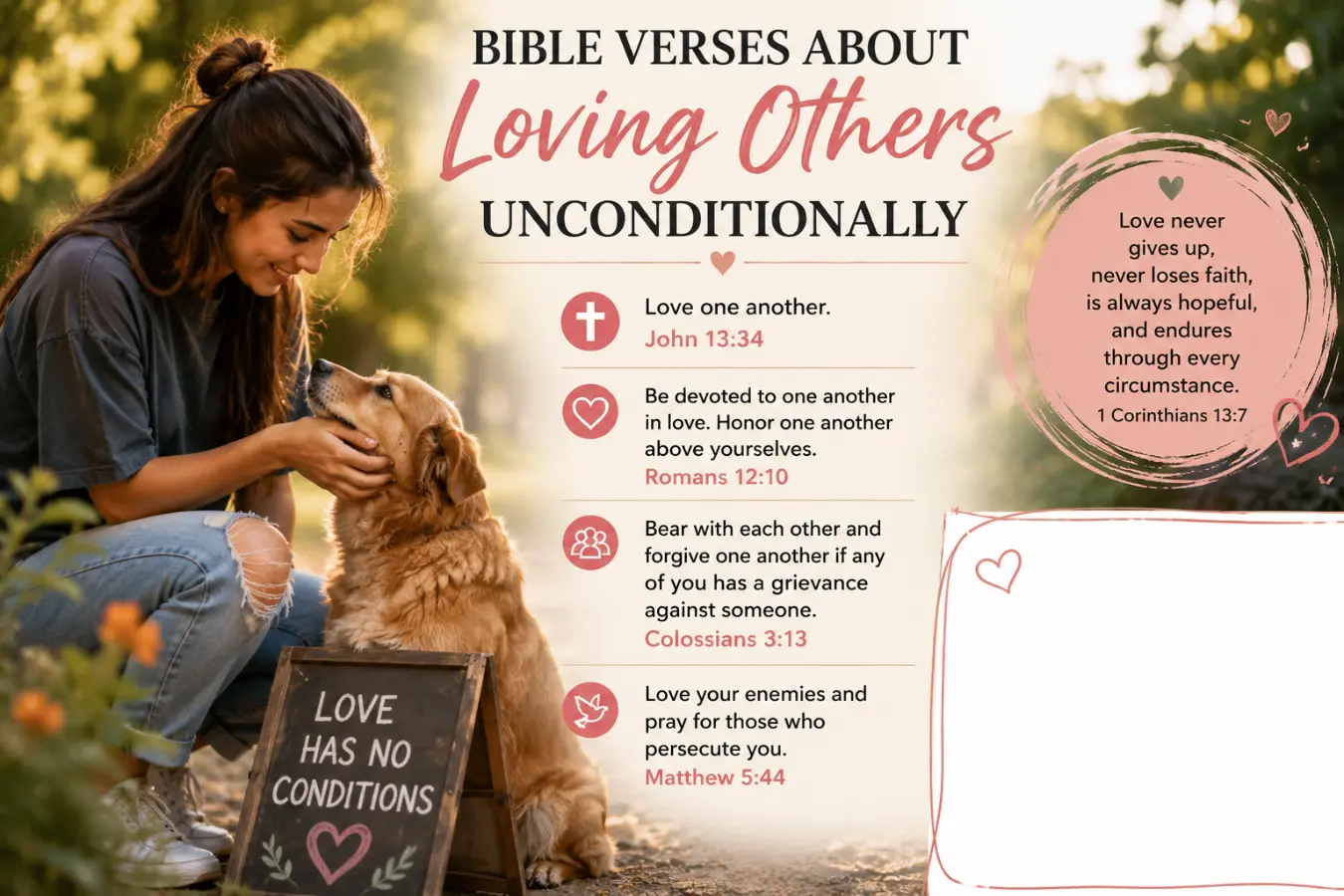
Bible Verses About Loving Others Unconditionally highlights the core message of God’s love, showing believers that true Christianity is rooted in compassion, mercy, and selfless care for others. It reminds readers that faith is not only about belief but also about action expressed through love and kindness.
In Scripture, love is described as sacrificial and selfless, and Bible Verses About Loving Others Unconditionally teaches believers how to reflect God’s love in daily life through patience, kindness, and forgiveness toward everyone, even those who are difficult to love. It emphasizes living according to Christ’s example rather than human limitations.
Understanding Bible Verses About Loving Others Unconditionally helps Christians build compassion, forgiveness, and unity in relationships, strengthening both faith and character while guiding practical actions that reflect Christ’s teachings in everyday life.
1. John 15:12–13 (KJV)
Verse:
“This is my commandment, That ye love one another, as I have loved you.
Greater love hath no man than this, that a man lay down his life for his friends.”
Commentary:
Jesus defines the highest form of love as self-sacrifice. True friendship reflects willingness to put others first, even at personal cost. In daily life, this means choosing forgiveness, support, and loyalty over selfishness.
Cross-reference: Romans 5:8
2. 1 Corinthians 13:4–7 (KJV)
Verse:
“Charity suffereth long, and is kind; charity envieth not; charity vaunteth not itself, is not puffed up,
Doth not behave itself unseemly, seeketh not her own, is not easily provoked, thinketh no evil;
Rejoiceth not in iniquity, but rejoiceth in the truth;
Beareth all things, believeth all things, hopeth all things, endureth all things.”
Commentary:
Often called the “love chapter,” this passage defines unconditional love in action. It shows that love is patient, forgiving, and enduring. In friendships, it encourages us to remain steady even during misunderstandings.
Cross-reference: Galatians 5:22–23
3. Romans 12:9–10 (KJV)
Verse:
“Let love be without dissimulation. Abhor that which is evil; cleave to that which is good.
Be kindly affectioned one to another with brotherly love; in honour preferring one another.”
Commentary:
Paul emphasizes sincere love—free from hypocrisy. Genuine friendship values others above self. Practically, it calls us to show respect, honesty, and humility in relationships.
Cross-reference: Philippians 2:3
4. Matthew 22:37–39 (KJV)
Verse:
“Jesus said unto him, Thou shalt love the Lord thy God with all thy heart, and with all thy soul, and with all thy mind.
This is the first and great commandment.
And the second is like unto it, Thou shalt love thy neighbour as thyself.”
Commentary:
Jesus connects love for God with love for people. Unconditional love for others flows naturally from loving God fully. This includes kindness even toward those who are difficult to love.
Cross-reference: Leviticus 19:18
5. 1 John 4:7–8 (KJV)
Verse:
“Beloved, let us love one another: for love is of God; and every one that loveth is born of God, and knoweth God.
He that loveth not knoweth not God; for God is love.”
Commentary:
This verse clearly states that love is the evidence of knowing God. A life without love is spiritually incomplete. In friendships, love becomes the defining mark of true faith.
Cross-reference: 1 John 4:16
6. Colossians 3:12–14 (KJV)
Verse:
“Put on therefore, as the elect of God, holy and beloved, bowels of mercies, kindness, humbleness of mind, meekness, longsuffering;
Forbearing one another, and forgiving one another…
And above all these things put on charity, which is the bond of perfectness.”
Commentary:
Paul describes love as the “bond of perfection.” Unconditional love holds relationships together through forgiveness and humility. It teaches believers to respond gently, even when wronged.
Cross-reference: Ephesians 4:32
7. Proverbs 17:17 (KJV)
Verse:
“A friend loveth at all times, and a brother is born for adversity.”
Commentary:
True friendship is consistent, not seasonal. A real friend remains supportive during hardship, not only in good times. This reflects unconditional loyalty and care.
Cross-reference: Ecclesiastes 4:9–10
8. Luke 6:35 (KJV)
Verse:
“But love ye your enemies, and do good, and lend, hoping for nothing again…”
Commentary:
Jesus expands love beyond friendship to include even enemies. This is the highest form of unconditional love. In practice, it means showing kindness without expecting reward.
Cross-reference: Matthew 5:44
9. Ephesians 4:2 (KJV)
Verse:
“With all lowliness and meekness, with longsuffering, forbearing one another in love;”
Commentary:
Paul teaches humility and patience in relationships. Loving others unconditionally requires endurance and gentleness, especially when conflicts arise.
Cross-reference: Colossians 3:13
10. 1 Peter 4:8 (KJV)
Verse:
“And above all things have fervent charity among yourselves: for charity shall cover the multitude of sins.”
Commentary:
Love has the power to forgive and heal brokenness. Strong friendships are built on forgiveness rather than judgment. This verse reminds believers to prioritize love above all faults.
Cross-reference: Proverbs 10:12
Note on Sources
The commentary in this article is informed by general biblical scholarship and widely respected study resources, including insights consistent with the ESV Study Bible and traditional Christian teaching. Interpretations aim to remain faithful to historical and theological context.
Conclusion
The Bible presents unconditional love as the foundation of all relationships, especially friendship. From patience and forgiveness to sacrifice and kindness, these verses show that true love is active, consistent, and selfless.
In everyday life, applying these teachings means choosing grace over judgment, loyalty over convenience, and compassion over indifference. When believers practice this kind of love, their friendships become a reflection of God’s own love—steady, forgiving, and eternal.