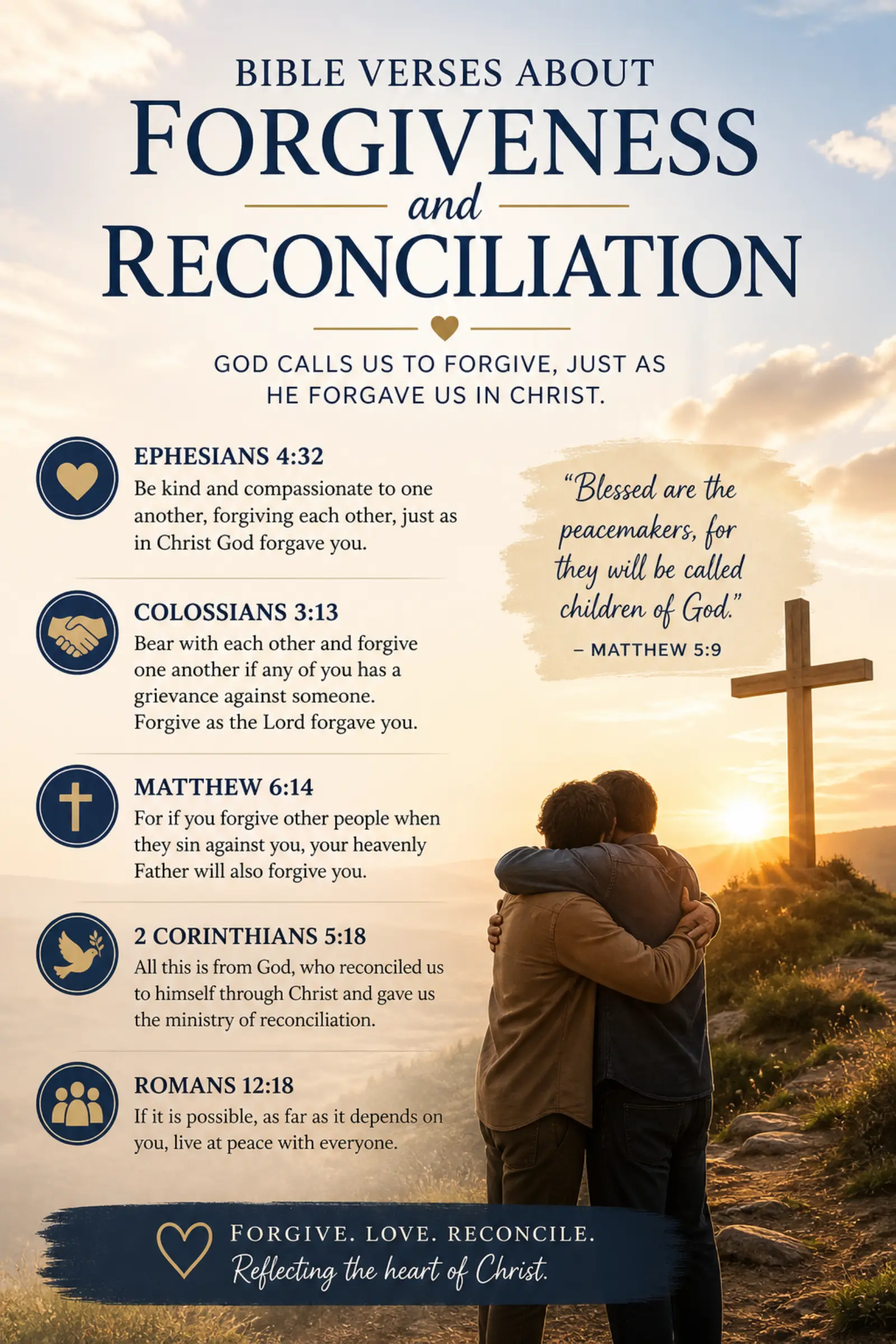
Forgiveness and reconciliation are central themes in the Christian faith, offering believers a path toward healing, peace, and restored relationships. Bible Verses About Forgiveness and Reconciliation remind us that God calls His followers not only to seek forgiveness but also to extend it to others, reflecting His mercy in everyday life. Through Scripture, we learn how forgiveness breaks the cycle of resentment and opens the door to spiritual growth.
In moments of conflict or emotional pain, Bible Verses About Forgiveness and Reconciliation provide guidance rooted in God’s wisdom, encouraging humility, compassion, and understanding. These verses emphasize that reconciliation is not just about repairing relationships with others, but also about restoring our relationship with God through obedience and grace.
Studying Bible Verses About Forgiveness and Reconciliation helps believers apply biblical principles in modern life, strengthening families, friendships, and communities. This EEAT-focused reflection is grounded in scriptural truth, offering reliable and faith-based insight into how forgiveness transforms hearts and restores broken bonds.
1. Matthew 6:14–15 (KJV)
Verse:
“For if ye forgive men their trespasses, your heavenly Father will also forgive you:
But if ye forgive not men their trespasses, neither will your Father forgive your trespasses.”
Explanation:
Jesus clearly connects our forgiveness of others with God’s forgiveness toward us. This teaches that unforgiveness blocks spiritual growth and relationship with God.
Modern Application:
In daily life, whether in family or friendships, choosing forgiveness keeps our hearts free from bitterness and allows healthy relationships to grow.
Cross-reference: Ephesians 4:32
2. Ephesians 4:32 (KJV)
Verse:
“And be ye kind one to another, tenderhearted, forgiving one another, even as God for Christ’s sake hath forgiven you.”
Explanation:
Paul encourages believers to mirror God’s forgiveness. Kindness and compassion are essential for reconciliation.
Modern Application:
Practicing empathy during conflicts helps restore broken trust in friendships and family relationships.
Note: This interpretation aligns with themes emphasized in the ESV Study Bible commentary on Christian ethics.
3. Colossians 3:13 (KJV)
Verse:
“Forbearing one another, and forgiving one another, if any man have a quarrel against any: even as Christ forgave you, so also do ye.”
Explanation:
Forgiveness is rooted in Christ’s example. Believers are called to patience and endurance in relationships.
Modern Application:
Instead of ending relationships quickly during disagreements, believers are encouraged to seek reconciliation.
4. Matthew 18:21–22 (KJV)
Verse:
“Then came Peter to him, and said, Lord, how oft shall my brother sin against me, and I forgive him? till seven times?
Jesus saith unto him, I say not unto thee, Until seven times: but, Until seventy times seven.”
Explanation:
Jesus teaches limitless forgiveness, symbolizing a heart always ready to reconcile.
Modern Application:
True friendship requires repeated forgiveness, not keeping score of wrongs.
5. Luke 6:37 (KJV)
Verse:
“Judge not, and ye shall not be judged: condemn not, and ye shall not be condemned: forgive, and ye shall be forgiven.”
Explanation:
Jesus emphasizes a non-judgmental heart that promotes peace and reconciliation.
Modern Application:
Avoiding harsh judgment helps maintain healthy relationships and prevents unnecessary conflicts.
6. Romans 12:18 (KJV)
Verse:
“If it be possible, as much as lieth in you, live peaceably with all men.”
Explanation:
Paul acknowledges that peace depends on effort and willingness.
Modern Application:
Even when others are difficult, believers are encouraged to take initiative in restoring peace.
7. 2 Corinthians 5:18–19 (KJV)
Verse:
“And all things are of God, who hath reconciled us to himself by Jesus Christ, and hath given to us the ministry of reconciliation;
To wit, that God was in Christ, reconciling the world unto himself…”
Explanation:
Reconciliation is part of God’s plan through Christ, and believers are called to continue this ministry.
Modern Application:
Christians should actively work to restore broken relationships, reflecting God’s reconciling love.
Note: This reflects central theological teaching found in standard evangelical commentaries such as the ESV Study Bible.
8. Proverbs 17:9 (KJV)
Verse:
“He that covereth a transgression seeketh love; but he that repeateth a matter separateth very friends.”
Explanation:
Love chooses to overlook faults, while gossip and repetition of wrongs destroy friendships.
Modern Application:
Avoid bringing up past mistakes repeatedly in relationships; instead, choose healing and discretion.
9. Hebrews 12:14 (KJV)
Verse:
“Follow peace with all men, and holiness, without which no man shall see the Lord.”
Explanation:
Peace is not optional but a requirement for a holy life.
Modern Application:
Pursuing peace actively strengthens both spiritual life and human relationships.
10. 1 John 1:9 (KJV)
Verse:
“If we confess our sins, he is faithful and just to forgive us our sins, and to cleanse us from all unrighteousness.”
Explanation:
God’s forgiveness is guaranteed when we confess honestly.
Modern Application:
Confession and honesty are essential steps in reconciliation with both God and others.
Conclusion
The Bible consistently teaches that forgiveness and reconciliation are central to a faithful Christian life. These verses show that forgiveness is not weakness but strength.it restores relationships, reflects God’s mercy, and brings peace into our hearts. If in friendships, family, or community, practicing biblical forgiveness leads to deeper trust and spiritual maturity. By following these teachings, believers can build relationships that honor God and reflect His love in everyday life.